





Battery Types for UPS Inverters: Lead-acid vs Lithium-ion
- Why battery choice matters for UPS systems
- UPS objectives and battery roles
- Key performance metrics to evaluate
- Standards and authoritative guidance
- Technical comparison: Lead-acid vs Lithium-ion
- Electrical and electrochemical characteristics
- Cycle life, DoD and calendar life
- Thermal behavior and safety
- Sizing, runtime and integration with UPS inverters
- Runtime calculation and practical example
- Charging profiles and inverter-charger compatibility
- Battery management and maintenance considerations
- Cost, lifecycle economics and suitability by application
- Total cost of ownership (TCO) factors
- Application-driven recommendations
- Environmental considerations and recycling
- Implementation checklist for selecting batteries for your UPS power inverter
- Essential pre-purchase questions
- Integration best practices
- Comparative summary table
- Manufacturer capabilities and a case for experienced suppliers
- Why supplier expertise matters
- About Guangzhou Congsin Electronic Technology Co., Ltd.
- Congsin product relevance to battery selection
- Practical recommendations and next steps
- Selecting the right chemistry
- Working with your inverter supplier
- Monitoring and maintenance plan
- FAQ (Frequently Asked Questions)
- 1. Which battery is best for a UPS: lead-acid or lithium-ion?
- 2. Can I replace lead-acid batteries with lithium-ion in my existing ups power inverter?
- 3. How do I size a battery bank for a 5 kW UPS system?
- 4. What safety measures are required for lithium-ion batteries on UPS installations?
- 5. How often should UPS batteries be tested or replaced?
- 6. Are there rebates or incentives for switching to lithium-ion for backup power?
- Contact and next steps
Choosing the right battery chemistry for an ups power inverter is a decision that affects reliability, runtime, total cost of ownership (TCO), safety and maintenance. This article compares lead-acid and lithium-ion batteries across technical, operational and commercial dimensions, provides sizing and selection guidance, and highlights how manufacturers like Guangzhou Congsin Electronic Technology Co., Ltd. support different configurations for residential, commercial and mobile inverter systems.
Why battery choice matters for UPS systems
UPS objectives and battery roles
An ups power inverter's primary functions are to provide instantaneous AC power during mains failure, condition power (voltage/frequency regulation), and protect critical loads. The battery is the energy reservoir: its chemistry determines usable capacity, available runtime, recharge speed, environmental tolerance and maintenance needs. Different use cases—short emergency shutdowns, long backup for servers, or daily cycling in off-grid solar systems—demand different battery attributes.
Key performance metrics to evaluate
When comparing battery types for inverters, use these metrics: energy density (Wh/kg), volumetric density (Wh/L), cycle life (cycles to specified depth-of-discharge and end-of-life percentage), calendar life, charge/discharge efficiency (round-trip), cost per kWh (capex), depth-of-discharge (DoD) capability, temperature sensitivity and safety characteristics. These directly affect inverter sizing, cooling needs and lifecycle costs.
Standards and authoritative guidance
Industry standards and guidance inform safe integration: the lead-acid battery and lithium-ion battery technical references summarize basic properties, while UPS-specific battery recommendations and installation practices are embodied in resources such as APC/Eaton application notes and IEEE guidelines (see for example APC's battery FAQ APC Battery FAQ).
Technical comparison: Lead-acid vs Lithium-ion
Electrical and electrochemical characteristics
Lead-acid (including flooded, AGM and gel VRLA types) delivers robust, low-cost energy storage with relatively low energy density and lower cycle life. Lithium-ion (with chemistries such as NMC, LFP/LiFePO4) offers higher energy density, higher usable DoD, faster recharge and higher cycle life. Lithium-ion also usually includes an integrated battery management system (BMS) to manage cell balancing, thermal and over/under-voltage protections—important for inverter integration.
Cycle life, DoD and calendar life
Typical ranges (industry sources such as Battery University and published datasheets):
| Metric | Lead-acid (VRLA/AGM) | Lithium-ion (LiFePO4 / NMC) |
|---|---|---|
| Energy density (Wh/kg) | 30–50 | 100–260 |
| Cycle life (typical) | 300–1,200 (depends on DoD & type) | 1,000–6,000 (chemistry & DoD dependent) |
| Usable DoD | 30–50% (recommended for long life) | 70–95% (depending on chemistry & management) |
| Calendar life | 3–8 years | 5–15+ years |
| Round-trip efficiency | 70–85% | 85–95% |
| Typical cost (capex per usable kWh) | Lower upfront but higher TCO | Higher upfront, lower TCO over lifetime |
Sources: Wikipedia - Lead-acid, Wikipedia - Lithium-ion, Battery University.
Thermal behavior and safety
Lead-acid tolerates moderate temperature variation but suffers accelerated aging at elevated temperatures and can off-gas hydrogen in flooded designs. Lithium-ion offers high energy density but requires robust BMS and thermal management; some chemistries (e.g., NMC) are more thermally sensitive than LiFePO4, which is known for stable thermal and chemical behavior. Safety certifications, inverter integration protocols and proper enclosure design reduce risks for both chemistries.
Sizing, runtime and integration with UPS inverters
Runtime calculation and practical example
Basic runtime estimate for an ups power inverter:
Runtime (hours) = Battery usable capacity (Wh) / Load power (W)
Example: A 5 kW inverter supporting a 2 kW critical load with a 48 V battery bank and 1 kWh usable battery capacity:
- Battery usable capacity = nominal capacity (kWh) × usable DoD
- If using a 10 kWh lithium battery with 80% usable DoD → usable = 8 kWh
- Runtime = 8,000 Wh / 2,000 W = 4 hours
Remember to factor inverter efficiency (e.g., 90–95%), BMS consumption, and temperature derating.
Charging profiles and inverter-charger compatibility
Lead-acid batteries typically require specific charge voltages and acceptance profiles (multi-stage charging with bulk, absorption, float phases). Lithium-ion accepts faster charging and often benefits from CC-CV profiles with lower float voltage. Many modern UPS power inverters include configurable charge algorithms to support either lead-acid or lithium-ion; confirm firmware/settings or use external chargers matched to battery chemistry.
Battery management and maintenance considerations
Lead-acid needs periodic inspection (for flooded cells), occasional equalization and temperature-compensated charging. VRLA/AGM reduces maintenance but has limited calendar life. Lithium-ion systems require a BMS for cell balancing, state-of-charge (SoC) estimation and protection; BMS health is critical and should be monitored by the inverter/monitoring system (via CAN, RS485, or Modbus where supported).
Cost, lifecycle economics and suitability by application
Total cost of ownership (TCO) factors
TCO includes capital expense, installation, maintenance, replacement cycles and energy losses. While lead-acid batteries have lower initial cost per kWh, their shorter cycle life and shallower usable DoD often produce higher replacement frequency. Lithium-ion’s higher upfront cost is frequently offset by longer service life and higher usable capacity—resulting in lower LCOE (levelized cost of energy) for many high-utilization scenarios. For backup systems with infrequent use and limited runtime requirements, lead-acid can still be cost-effective.
Application-driven recommendations
Match chemistry to the use case:
- Critical data centers and telecom with frequent deep cycling or high reliability needs: lithium-ion preferred due to predictable end-of-life, smaller footprint and lower maintenance.
- Residential backup with occasional short outages and tight budget: VRLA/AGM lead-acid remains viable.
- Off-grid solar systems with daily cycling: lithium-ion (LiFePO4) often superior because of higher cycle life and better DoD.
- Mobile applications (RVs, trucks): lithium-ion favored for weight/space savings and higher usable capacity; ensure inverter supports the BMS interface.
Environmental considerations and recycling
Lead-acid batteries are highly recyclable with established collection networks, but they are heavy and contain lead and sulfuric acid requiring careful disposal. Lithium-ion recycling is an evolving industry; recovery of valuable metals is improving and is encouraged by regulations in many regions. Consider end-of-life pathways in procurement decisions.
Implementation checklist for selecting batteries for your UPS power inverter
Essential pre-purchase questions
Ask suppliers and integrators these before buying:
- What is the required runtime at specified load and inverter efficiency?
- Is the inverter compatible with the battery's BMS and recommended charge profile?
- What ambient temperature ranges will the battery see, and are there derating curves?
- What monitoring and remote telemetry (Modbus, CAN) are provided?
- What certifications (UL, CE, UN38.3 for transport) and warranties are provided?
Integration best practices
Use appropriately sized cabling and fusing, match DC bus voltage between inverter and battery bank, ensure adequate ventilation or thermal control, configure charge parameters and BMS communication, and establish preventative maintenance and monitoring routines. Follow manufacturer installation guides and relevant standards for battery installation and electrical safety such as IEC/IEEE guidelines where applicable.
Comparative summary table
| Factor | Lead-acid (VRLA/AGM) | Lithium-ion (LiFePO4 / NMC) |
|---|---|---|
| Initial cost | Lower | Higher |
| Lifespan (calendar & cycles) | Shorter | Longer |
| Maintenance | Periodic (flooded) / low (VRLA) | Low but requires BMS monitoring |
| Weight & volume | Heavy, bulky | Lightweight, compact |
| Safety | Well-understood, venting risk for flooded | Requires robust BMS and thermal management |
| Best fit | Low-duty backup, budget-constrained | High-cycle, space/weight-constrained, long-term TCO |
Manufacturer capabilities and a case for experienced suppliers
Why supplier expertise matters
Successful integration of batteries with ups power inverters requires not just the batteries but matching charge control, firmware, mechanical design and after-sales support. An experienced manufacturer can provide validated inverter-battery pairings, OEM/ODM options, compliance test data and customization for vehicle, off-grid, or telecommunication deployments.
About Guangzhou Congsin Electronic Technology Co., Ltd.
Guangzhou Congsin Electronic Technology Co., Ltd., founded in early 1998, is a professional power inverter manufacturer with over 27 years of focused experience. We design, R&D and manufacture a wide range of power solutions—with a core emphasis on DC→AC power inverters, portable power stations, and solar charge controllers. Our catalog includes 100+ models tailored for vehicles, solar systems, RVs and trucks, off-grid homes, outdoor offices, patrol and field construction work.
We operate fully automated production lines, advanced instrumentation and multifunctional testing equipment to ensure product reliability, efficiency and intelligent functionality. Environmental and safety compliance are built in: our quality system is ISO9001 certified and many products hold international approvals such as CE, EMC, LVD, ETL, FCC, RoHS and E-MARK. Several independently developed patents further demonstrate our commitment to innovation.
Congsin’s products serve global markets across Europe, the Americas, the Middle East, Africa and Southeast Asia; many models are supplied to domestic and international OEM channels. Our support includes OEM/ODM, private labeling, distribution and bespoke customization to meet partner specifications.
Our mission is to deliver reliable, efficient and affordable energy solutions that enable energy independence.
Congsin product relevance to battery selection
For integrators using Congsin pure sine wave inverters, modified sine wave inverters, portable power stations and solar charge controllers, the company provides compatible charge settings, BMS communication options and system integration advice—helping customers select between lead-acid and lithium-ion options based on application needs, space constraints and lifecycle economics.
Practical recommendations and next steps
Selecting the right chemistry
Start with use-case and budget: for frequent cycling, space-constrained or mobile installations choose lithium-ion (preferably LiFePO4 for safety/stability); for infrequent, short-duration backup on a tight budget consider VRLA/AGM lead-acid. Always compare TCO over the expected system life, not just upfront cost.
Working with your inverter supplier
Confirm your ups power inverter supports the battery type (charge algorithm, BMS comms, voltage range). Request test reports, warranty terms, and reference installations. If retrofitting a lithium battery to an inverter previously used with lead-acid, verify charger settings and protective functions.
Monitoring and maintenance plan
Implement remote monitoring to track SoC, charge cycles, temperature and BMS alerts. Plan for preventive replacements based on cycles and calendar life. For lead-acid keep maintenance logs for electrolyte/equalization where applicable; for lithium, monitor BMS health and cell balance reports.
FAQ (Frequently Asked Questions)
1. Which battery is best for a UPS: lead-acid or lithium-ion?
It depends on your application. For long-life, frequent cycling, space/weight constraints and lower lifecycle cost, lithium-ion (especially LiFePO4) is generally better. For low-frequency, short-duration backup where upfront cost is the main constraint, lead-acid (VRLA/AGM) can be acceptable.
2. Can I replace lead-acid batteries with lithium-ion in my existing ups power inverter?
Possibly, but you must ensure the inverter's charger and firmware are compatible with lithium charging profiles and that BMS communications are integrated or tolerant. Consult the inverter manufacturer or a systems integrator before retrofitting.
3. How do I size a battery bank for a 5 kW UPS system?
Calculate runtime using usable battery Wh divided by load W, and factor inverter efficiency and DoD. Example: for 2 kW load and 4 hours runtime with 90% inverter efficiency, required usable energy = (2,000 W × 4 h)/0.9 ≈ 8,889 Wh. Choose battery capacity and chemistry that provide that usable energy at desired DoD.
4. What safety measures are required for lithium-ion batteries on UPS installations?
Use certified batteries with integrated BMS, provide appropriate thermal management, ensure proper enclosure ventilation/protection, include fire detection/suppression where required by code, and follow transport and disposal regulations such as UN38.3 tests for shipping.
5. How often should UPS batteries be tested or replaced?
Test batteries periodically per manufacturer recommendations. Lead-acid typically require replacement every 3–8 years depending on usage and environment; lithium-ion often last 8–15+ years depending on cycles and operating conditions. Use runtime tests and capacity checks to decide on replacement timing.
6. Are there rebates or incentives for switching to lithium-ion for backup power?
In some jurisdictions, energy storage incentives, tax credits or grants apply for grid-interactive or solar-coupled storage systems. Check local utility programs and government incentives. For technical standards and program details, consult local authorities and program websites.
Contact and next steps
If you need help specifying batteries for your ups power inverter project, or want matched inverter-battery solutions, contact Guangzhou Congsin Electronic Technology Co., Ltd. for product catalogs, OEM/ODM options, and system design support. Browse product ranges including Solar Charge Controller, modified sine wave inverter, pure sine wave inverter and portable power stations, or request a consultation to evaluate lead-acid vs lithium-ion for your specific needs.
For standards and deeper technical reading: see Lithium-ion battery (Wikipedia), Lead-acid battery (Wikipedia), and manufacturer application notes such as APC Battery FAQ.
Camping Power: Using an Inverter with a Car Battery Effectively
Load Compatibility and Efficiency with Modified Sine Wave Inverters
How to Choose the Right Pure Sine Wave Inverter Size and Wattage
Maximizing Efficiency of Your 2000W Modified Sine Wave Inverter
Modified Sine Wave Inverters
How to connect the battery with the battery clip?
Connect the positive and negative poles of the battery clip to the positive and negative poles of the battery respectively, and ensure a firm connection.
Which plug types are supported by the universal socket?
The universal socket is compatible with most national plug specifications, such as GB, US, EU, etc., and can meet the use of devices in different regions (some require adapters).
What power appliance can this inverter run?
It has a continuous power of 800W, so it can run appliances within 800W; the peak power is 1500W, supporting the instantaneous startup of appliances within 1500W.
Is the dual input automatically recognized or manually switched?
Automatically recognize DC12V/24V input, no manual switching required.
Can 4 USB ports fast charge at the same time?
Yes, 4 USB ports can fast charge mobile phones, tablets and other devices at the same time, meeting the needs of simultaneous charging of multiple devices.
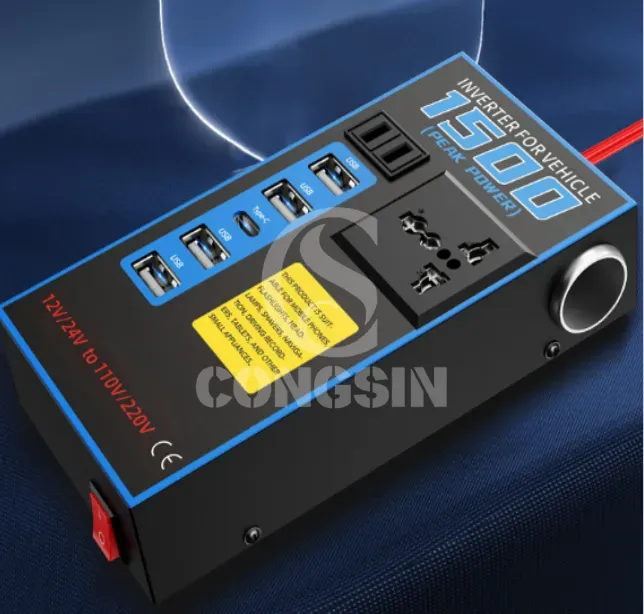
Congsin 1500W Inverter for Vehicle DC 12V/24V to AC 110V/220V with Universal socket Modified Sine Wave
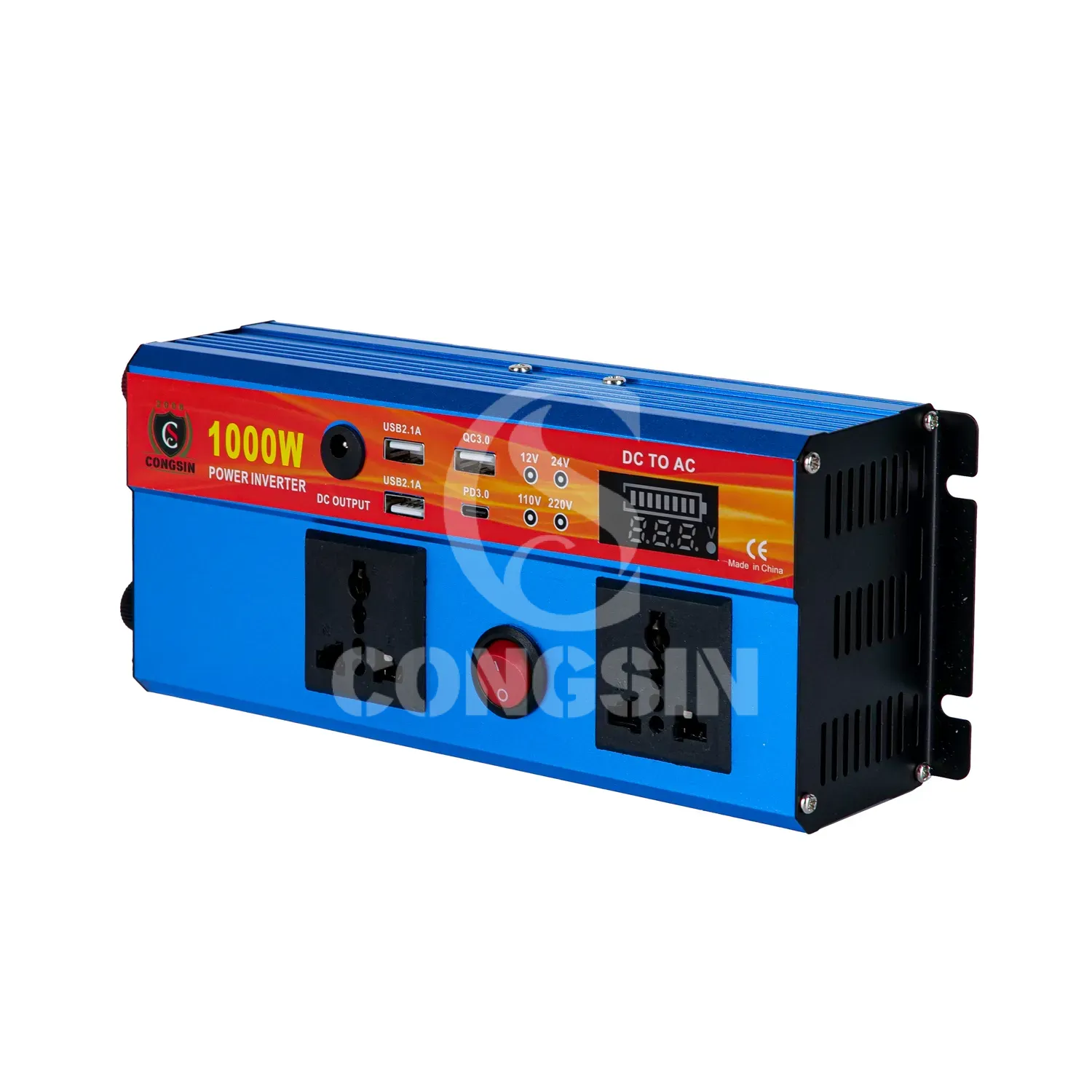
Congsin 1000W modified sine wave inverter with LED display and Type C port car RV power inverter
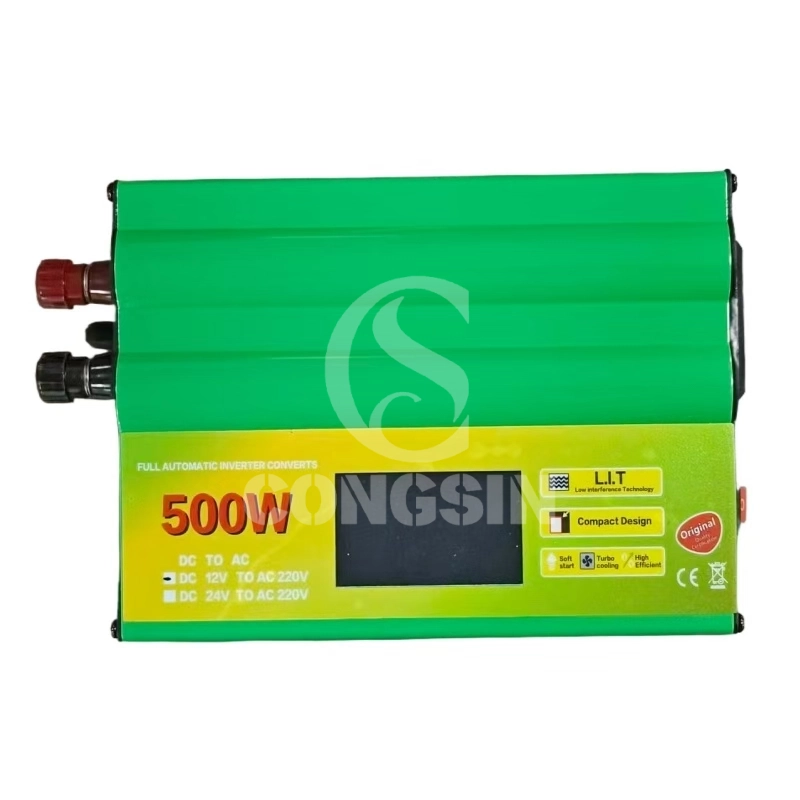
Congsin Modified Sine Wave Inverter 500W 1000W 1500W 12V LED Display Portable for RV Car Solar
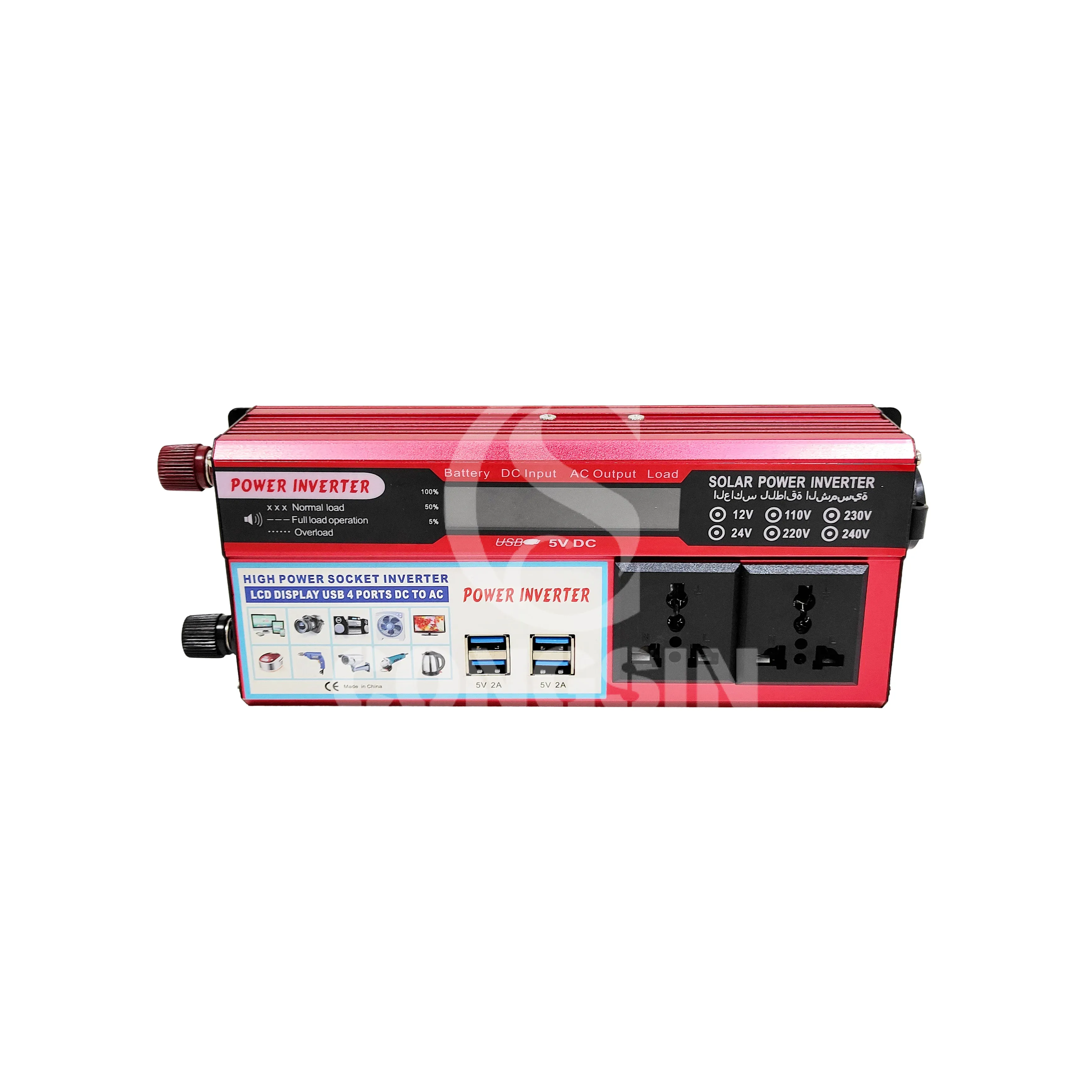
Congsin 1500W modified sine wave inverter with LCD display and USB ports for RV car boat home use

CONGSIN is a trusted OEM factory for power inverters, solar charge controllers, and DC converters. Reliable solutions for global B2B buyers.
 High Quality
 7/24 Service
 Guaranteed Warranty
© 2025 Congsin. All Rights Reserved.